

Disclosure: This guide may include internal links to related resources on this site and external links to official Portuguese and EU sources. Some internal links may point to pages that contain affiliate or partner offers; where that is the case, it will be stated clearly on that page.
Finding a job in Portugal involves more than sending a CV to a few companies. A successful job search usually requires choosing the right vacancies, preparing a targeted CV, understanding Portuguese and EU employment requirements, checking whether you have the right to work, and following each employer’s application instructions carefully.
I’ve helped review and edit dozens of applications from job seekers targeting Portugal over the past few years — from software developers in Lisbon to hospitality staff in the Algarve — and the same few mistakes come up again and again: generic CVs, skipped work-authorization checks, and applying to vacancies that turn out to be scams. This guide is built around fixing exactly those gaps.
This guide explains how to apply for jobs in Portugal, where to search, what to include in your application, what international applicants should know, and how to avoid common job-search mistakes.
1. Check Your Right to Work in Portugal
Before applying, determine whether you already have the legal right to work in Portugal.
EU, EEA and Swiss citizens
Citizens of the European Union, European Economic Area countries and Switzerland generally have a different mobility and employment position from applicants coming from outside Europe. If you are in this group, check the current registration and residence requirements that apply to your situation.
The Portuguese employment service, IEFP, provides information for people looking for employment and distinguishes identification requirements according to nationality.
Non-EU applicants
If you are a citizen of a country outside the EU/EEA/Switzerland, do not assume that applying for a vacancy automatically gives you permission to work in Portugal.
Portugal has specific immigration procedures for employment. AIMA, Portugal’s Agency for Integration, Migration and Asylum, provides information on residence authorization for employment, including routes involving a residence visa and a job-search visa.
IEFP also publishes vacancies specifically intended for non-EU citizens who are still living outside Portugal. These listings can allow eligible applicants to submit their CV to Portuguese employers while abroad.
Important: Immigration and work-authorization rules can change. Always check the current requirements with the relevant Portuguese authority before making travel or employment decisions.
2. Decide What Type of Job You Are Looking For
A focused job search is usually more effective than applying for every vacancy you see.
Start by identifying:
- Your occupation or target job title
- Your experience level
- Your strongest professional skills
- Your preferred location in Portugal
- Whether you need full-time, part-time, temporary or permanent work
- Whether you are willing to work remotely or on-site
- Your language skills
- Whether you need an employer willing to consider international applicants
For example, instead of searching only for “jobs in Portugal,” a candidate could search for terms such as:
- Software developer jobs in Lisbon
- Hotel jobs in Algarve
- English-speaking jobs in Portugal
- Warehouse jobs in Porto
- Customer service jobs in Portugal
- Nursing jobs in Portugal
- Construction jobs in Portugal
The more specific the search, the easier it becomes to identify vacancies that actually match your background. For a running list of current openings organized by role and city, see JobQora’s Portugal job listings, which we update as a companion resource to this guide.
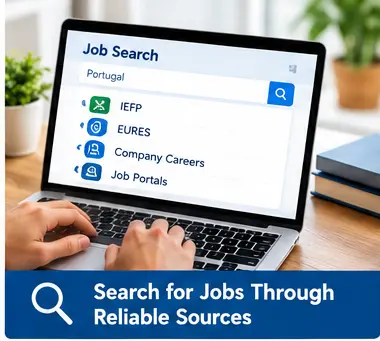
3. Search for Jobs Through Reliable Sources
One of the most important steps is choosing legitimate places to search.
IEFP
The Portuguese public employment service, IEFP, provides employment-related services and vacancy information. Job seekers can register for employment services and access vacancies, training opportunities and other employment support.
EURES
EURES is particularly useful for people looking for employment opportunities across Europe. IEFP recommends using EURES to search for vacancies with Portuguese employers and provides information about the Portuguese labour market.
EURES also works with Europass, allowing job seekers to create a profile and share their CV with employers and employment services across Europe.
Employer career pages
If you already know which companies interest you, visit their official career pages. Applying directly through an employer’s website can help you confirm that the vacancy is genuine and understand the company’s own application process.
Other job platforms
Commercial job boards can also be useful, but applicants should check who is publishing the vacancy, whether the employer can be identified, and whether the application process looks legitimate. JobQora aggregates listings from verified sources as a starting point, but always cross-check the employer independently before applying, per the scam-prevention steps in Section 12.
4. Prepare a Portugal-Friendly CV
Your CV is often the first part of your application an employer sees, so make it easy to read and relevant to the vacancy.
A useful CV should normally include:
- Full name
- Contact details
- Location
- Professional summary, where appropriate
- Work experience
- Education
- Relevant qualifications
- Technical or professional skills
- Language skills
- Relevant certifications
- Driving licence, if relevant to the position
Do not send exactly the same CV to every employer.
Instead, adjust the document to highlight experience that directly relates to the vacancy. If a job requires customer service, for example, emphasize customer-facing experience rather than unrelated responsibilities. From reviewing applications that actually got interview callbacks versus those that didn’t, the single biggest difference was almost always a CV rewritten for the specific role — not a longer CV, just a more targeted one.
Consider Europass
Europass provides free tools for creating CVs and cover letters and allows users to maintain information about skills, qualifications and work experience. A Europass profile can also be shared with EURES.
However, you should still follow the employer’s specific application instructions if the company requests a particular CV format.
5. Write a Short, Targeted Cover Letter

A cover letter is not always required, but it can be useful when the employer asks for one or when your background needs additional explanation.
A good cover letter should answer three basic questions:
- Why are you applying for this position?
- What relevant experience or skills do you have?
- Why are you interested in working for this employer?
Keep it focused. Avoid repeating your entire CV.
For international applicants, it can also be useful to clearly state your current location and, where relevant, your work authorization status.
For example:
“I am currently based outside Portugal and am interested in opportunities that consider international applicants.”
Do not claim that you have Portuguese work authorization if you do not.
6. Check the Job Requirements Before Applying
Read the vacancy carefully before submitting your application.
Pay particular attention to:
- Required qualifications
- Professional experience
- Language requirements
- Required licences
- Location
- Working schedule
- Employment type
- Salary information
- Application deadline
- Work authorization requirements
- Documents requested by the employer
Some professions may also have professional or qualification-recognition requirements. These should be checked separately with the appropriate Portuguese authority or professional organization.
Do not assume that a qualification obtained in another country is automatically sufficient for every regulated profession.
7. Apply Exactly as the Employer Requests
Once your application documents are ready, follow the employer’s instructions.
A vacancy may ask you to:
- Apply through an online form
- Upload a CV
- Submit a cover letter
- Send an email
- Apply through a recruitment platform
- Complete an employer questionnaire
- Provide certificates or other documents
If the employer specifically asks for a CV in PDF format, send a PDF rather than an unrelated file type.
If an employer requests a specific subject line for an email application, use it.
Small details can make your application easier for a recruiter to process.
8. Applying for Jobs in Portugal From Abroad
You do not necessarily need to move to Portugal before starting your job search.
IEFP specifically provides information and vacancies for non-EU citizens who are not currently resident in Portugal. These vacancies may allow employers to receive applications from candidates who are still abroad.
For international applicants, a practical approach is:
Step 1: Identify jobs that match your experience.
Step 2: Check whether the employer accepts applications from candidates outside Portugal.
Step 3: Confirm the work-authorization requirements.
Step 4: Submit a professional CV and application.
Step 5: Attend interviews remotely if offered.
Step 6: If selected, follow the appropriate visa and residence process.
Do not pay an individual or agency simply because they claim they can guarantee a Portuguese job or visa.
9. Understand the Job-Search Visa Carefully

Portugal has a route for eligible foreign nationals who obtain a job-search visa.
AIMA explains that holders of a valid job-search visa may enter and remain in Portugal for the purpose of seeking subordinate employment and may work under the conditions described by the applicable rules. AIMA also sets out the process for applying for residence authorization after the employment relationship has been formalized.
The exact requirements and procedure should always be checked against the current official information before applying.
A job-search visa should not be treated as a guarantee that you will find employment.
10. Prepare for Interviews
If an employer responds to your application, prepare before the interview.
Research:
- The employer
- The position
- The responsibilities
- The industry
- The location
- The skills mentioned in the vacancy
Prepare examples showing how you handled relevant situations in previous jobs.
For international applicants, be prepared to explain:
- Where you currently live
- Your availability
- Your language skills
- Your professional experience
- Your work authorization situation
- When you could realistically start
If the interview is online, test your internet connection, microphone and camera beforehand.
11. Check the Employment Offer Before Accepting
Getting an offer is not the end of the process. Read the employment conditions carefully.
Check:
- Job title
- Employer’s legal identity
- Workplace
- Working hours
- Contract type
- Salary
- Payment arrangements
- Probationary conditions, if applicable
- Holiday arrangements
- Notice requirements
- Any deductions or employee contributions explained in the contract
Portugal’s national minimum wage is €920 per month in 2026 according to the Portuguese Government’s announcement. However, this does not mean every job pays €920; actual compensation depends on the position, contract and applicable rules.
When comparing vacancies, distinguish between gross and net pay and consider the overall employment conditions rather than focusing only on the headline salary.
12. Watch for Job Scams
International job seekers can be particularly vulnerable to recruitment scams.
Be cautious if someone:
- Guarantees you a job without an interview
- Guarantees a visa
- Demands large upfront fees
- Refuses to identify the employer
- Requests unusual financial payments
- Uses an unofficial email address while claiming to represent a major company
- Offers unusually high pay for very little work
- Pressures you to send sensitive documents immediately
- Tells you to ignore official immigration procedures
Verify the employer independently.
If a vacancy is advertised through a third party, try to find the company’s official website and confirm that the position exists.
A legitimate recruitment process should provide enough information for you to understand who is hiring, what the job involves and what the application process requires.
13. Common Mistakes When Applying for Jobs in Portugal
Avoid these common mistakes:
Sending a generic CV
A generic CV may fail to show why you are suitable for the particular position.
Applying without checking work authorization
If you are outside the EU/EEA/Switzerland, determine whether you have the appropriate route to work in Portugal before assuming you can start immediately.
Ignoring language requirements
Some jobs may require Portuguese, while others may operate partly or entirely in English. Read each vacancy individually.
Applying for jobs you are not qualified for
Focus on vacancies where your experience and qualifications genuinely match the employer’s requirements.
Providing inaccurate information
Never exaggerate your experience, qualifications or immigration status.
Paying for a guaranteed job
A promise of guaranteed employment or guaranteed visa approval should be treated as a major warning sign.
14. A Simple Job Application Checklist
Before submitting an application, use this checklist:
| Check | What to confirm |
|---|---|
| Job title | Is this the type of position you want? |
| Employer | Can you identify and verify the company? |
| Location | Where is the job based? |
| Requirements | Do you meet the essential requirements? |
| CV | Is your CV updated and relevant? |
| Cover letter | Is one required or useful? |
| Language | Do you meet the stated language requirements? |
| Work authorization | Are you legally able to work or eligible for the relevant route? |
| Documents | Have you supplied everything requested? |
| Application method | Did you follow the employer’s instructions? |
| Scam check | Have you verified the vacancy and employer? |
15. Frequently Asked Questions
Can foreigners apply for jobs in Portugal?
Yes, foreign nationals can apply for jobs in Portugal, but the rules differ depending on nationality and immigration status. Non-EU applicants may need the appropriate visa and residence authorization to work legally. IEFP provides information and specific vacancy listings for non-EU candidates seeking employment from abroad.
Can I apply for jobs in Portugal before moving there?
Yes. Some employers accept applications from people who are still outside Portugal. IEFP specifically publishes vacancies intended for non-EU citizens who are not resident in Portugal.
Where can I find jobs in Portugal?
Useful starting points include IEFP, EURES, employer career websites, and aggregator sites like JobQora. IEFP recommends searching its vacancy system and EURES for employment opportunities in Portugal.
Do I need to speak Portuguese to get a job in Portugal?
Not necessarily. The language requirement depends on the occupation and employer. Some positions may require Portuguese, while others may prioritize English or other languages. Always check the individual vacancy.
Is Europass useful when applying for jobs in Portugal?
Europass can be useful because it provides free tools for creating CVs and cover letters and can connect a candidate profile with EURES. However, applicants should follow the employer’s specific application requirements.
Do non-EU citizens need a work visa?
Non-EU citizens generally need the appropriate legal authorization to work in Portugal. The exact route depends on the person’s circumstances. AIMA provides current information on residence authorization for employment and job-search routes.
Can I get a Portuguese job while living abroad?
Yes, some Portuguese employers are willing to consider candidates who are still abroad. IEFP maintains a section for vacancies aimed at non-EU citizens living outside Portugal.
What should I do after receiving a job offer?
Review the employer, contract, salary, working conditions and your work-authorization requirements before accepting. If you need immigration permission, verify the current process through the relevant Portuguese authorities.
Conclusion
The best way to apply for jobs in Portugal is to combine a focused job search with a strong, targeted application and careful checking of employment and immigration requirements.
Start with legitimate vacancy sources such as IEFP, EURES and JobQora, prepare a clear CV, tailor each application to the position, and verify the employer before providing personal information or accepting an offer.
If you are applying from outside Portugal, pay particular attention to work authorization. A job application is only one part of the process; your ability to legally work in Portugal must also be established through the appropriate rules and procedures.
For current immigration requirements, employment procedures and official vacancies, always check the latest information from Portuguese authorities before making a move.
1 thought on “How to Apply for Jobs in Portugal: A Step-by-Step Guide for Job Seekers”