
Looking for full-time jobs in Portugal can be a good option if you want to build your career, gain international work experience, or move to Portugal for employment. Jobs are available in many different industries, although the requirements can vary depending on the position, employer, location, experience, and language skills.
In general, a full-time job in Portugal can involve up to 8 hours of work per day and 40 hours per week. Employees are also generally entitled to at least 22 working days of paid annual leave.
If you are currently looking for work, it helps to understand more than just where to find vacancies. You should also know what employers expect, how to prepare your application, and what international applicants need to check before accepting a job.
What Is a Full-Time Job in Portugal?
A full-time position in Portugal normally follows the country’s standard full-time working schedule.
According to the IEFP employment platform, the normal full-time working period is 8 hours per day and 40 hours per week. However, working arrangements can vary depending on the contract, occupation, and employment rules that apply to the position.
Before applying for or accepting a job, take a few minutes to check the details in the vacancy and employment contract.
Pay particular attention to:
- Working hours
- Work schedule
- Weekly days off
- Contract length
- Salary and payment terms
- Workplace location
- Required qualifications
- Probation period, where applicable
- Benefits and allowances
The Portuguese government also provides information about employment conditions, holidays, and workers’ rights.
Which Industries Offer Full-Time Jobs in Portugal?

Portugal has full-time employment opportunities in a wide range of industries. The jobs available to you will depend largely on your skills, qualifications, previous experience, language ability, and preferred location.
Here are some common areas worth exploring.
Hospitality and Tourism

Tourism is an important part of Portugal’s employment market, creating jobs in areas such as:
- Hotels
- Restaurants
- Guest services
- Housekeeping
- Kitchen operations
- Food and beverage
- Customer service
Some hospitality positions may be suitable for candidates who speak Portuguese, English, or other languages commonly used by international visitors.
Customer Service
Customer service and multilingual support roles can be particularly relevant for people who speak languages other than Portuguese.
EURES identifies customer service as one area where opportunities can exist for people who do not speak Portuguese. However, language requirements are different from one employer and vacancy to another.
Always read the individual job description carefully before applying.
Information Technology
Portugal also has opportunities in technology-related fields, including software development, IT support, data, and digital services.
Some companies advertise positions where English is used as the main working language. That said, you should not assume that English will be enough for every technology job. Check the language requirements listed by the employer.
Logistics and Warehousing
The logistics and warehousing sector offers several types of full-time positions, including:
- Warehouse operator
- Storekeeper
- Logistics assistant
- Order picker
- Inventory assistant
- Delivery and distribution roles
The requirements can vary considerably. Some positions may be open to candidates with limited experience, while others require previous warehouse work, technical knowledge, or specific licences.
Construction and Skilled Trades
Construction and skilled-trade jobs can include positions such as:
- Electrician
- Plumber
- Welder
- Construction worker
- Maintenance worker
- Technician
For regulated occupations, you may need to provide evidence of your qualifications or have your professional credentials formally recognised.
Healthcare and Care Work
Healthcare and social-care positions can involve specific education, professional registration, or qualification-recognition requirements.
If you have healthcare experience from another country, do not assume that you can automatically work in the same profession in Portugal. Check the professional recognition requirements with the relevant Portuguese authority before applying.
Do You Need to Speak Portuguese?
It depends on the job.
Portuguese is important for many positions, especially jobs that involve regular communication with customers, patients, colleagues, or members of the public.
However, there are also opportunities where Portuguese may not be essential. EURES identifies areas such as customer service, IT, agriculture, and some hotel and restaurant roles where opportunities may be available to people who do not speak Portuguese.
That does not mean every employer in these sectors accepts English-speaking applicants.
Before applying, check:
- What language level the employer requires.
- Whether Portuguese is mandatory.
- Whether English is sufficient.
- Whether another language is required.
- How much direct communication with customers or the public is involved.
If you plan to stay and work in Portugal for the long term, learning Portuguese can also make everyday life and communication at work easier.
Full-Time Jobs in Portugal for International Workers
If you are applying from outside Portugal, one of the first things to check is whether you have the legal right to work there.
EU/EEA and Swiss citizens have different mobility arrangements from people who are citizens of countries outside the EU/EEA.
For non-EU applicants, finding a job vacancy does not automatically give you permission to work in Portugal. EURES also points out that using its job-search services does not remove national requirements relating to work or residence permits.
For this reason, international job seekers should check their individual work-authorisation and immigration requirements with the relevant Portuguese authorities before making travel or employment plans.
For more information about working in Portugal, see our guide:
Working in Portugal: A Beginner’s Guide
How to Find Full-Time Jobs in Portugal
A job search is usually more effective when you use several reliable sources rather than depending on a single website.
1. Search the IEFP Job Portal
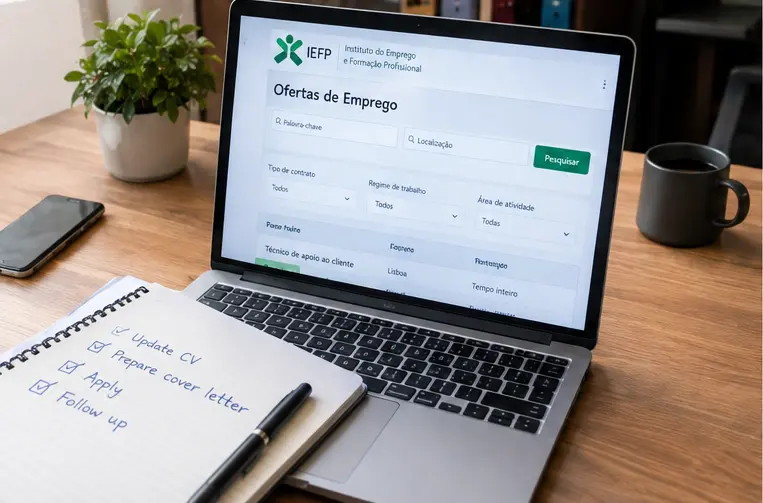
The Instituto do Emprego e Formação Profissional (IEFP) is Portugal’s public employment and vocational-training service.
Its online employment platform allows job seekers to search for vacancies and use filters, including the type of work arrangement.
Search official Portugal job vacancies through IEFP
2. Check EURES
EURES is a European network that supports job mobility across participating European countries.
The platform provides job-search services as well as information and guidance about living and working in different European countries.
3. Explore Company Career Pages
Many companies advertise vacancies directly through their own websites.
If there is a company you would like to work for, look for sections such as:
- Careers
- Jobs
- Recruitment
- Work with us
- Vacancies
- Join our team
Applying directly through a company’s career page can also give you a clearer idea of the employer’s requirements and recruitment process.
4. Use Professional Networks
Professional networks such as LinkedIn can be useful when searching for full-time positions, particularly for professional, technical, and international roles.
EURES notes that Portuguese employers and recruitment companies increasingly use platforms such as LinkedIn to find candidates, particularly for positions that require higher education qualifications.
How to Prepare Your CV for Portugal
Your CV should make it easy for a recruiter to understand your experience and see why you match the vacancy.
Include relevant information such as:
- Name and contact details
- Professional summary
- Relevant work experience
- Education
- Professional qualifications
- Technical skills
- Language skills
- Relevant certifications
- Driving licence, if required for the role
- Professional achievements
Try not to send exactly the same CV for every job.
For example, when applying for a warehouse position, put more emphasis on warehouse operations, inventory management, stock control, equipment experience, and relevant licences.
For a customer-service position, highlight communication skills, customer support experience, and your language abilities.
A CV that clearly matches the job description can make it easier for the employer to identify your relevant experience.
What Documents Should International Applicants Prepare?
The documents you need will depend on your nationality, profession, and employment situation.
EURES recommends preparing documents that demonstrate your work experience, education, and professional training. Professional certificates may also be important, particularly when applying for regulated professions.
Depending on your circumstances, you may need:
- Passport or identity document
- CV
- Education certificates
- Professional qualifications
- Evidence of work experience
- Professional licences
- Language certificates, where requested
- Employment documents
- Work or residence documentation, where applicable
Be careful when sharing personal documents. Do not send sensitive information to an employer or recruiter unless you understand why it is needed and who will receive it.
What Should You Check Before Accepting a Full-Time Job?
Getting a job offer is an important step, but it is still worth reviewing the employment terms carefully before you accept.
Salary
First, make sure you understand what the advertised salary actually represents.
Check whether the amount is:
- Gross or net
- Monthly or annual
- Base salary or total compensation
- Inclusive or exclusive of allowances
An advertised salary is not necessarily the same amount you will receive after taxes and other deductions.
Working Hours
Make sure you understand the normal working schedule and whether the job involves:
- Weekend work
- Night shifts
- Rotating shifts
- Overtime
- Split schedules
Portugal’s normal maximum limits for regular working hours are generally 8 hours per day and 40 hours per week, although particular arrangements can depend on applicable rules and agreements.
Contract Type
Check what type of contract you are being offered.
It could be:
- Permanent
- Fixed-term
- Temporary
- Full-time
- Part-time
The contract type can affect your employment conditions. For international workers, it may also be relevant to immigration or work-authorisation procedures.
Location
Don’t assume that a job advertised as being “in Portugal” is necessarily close to where you want to live.
The actual workplace could be in Lisbon, Porto, Braga, Faro, Cascais, or another municipality.
Always check the exact work location before accepting an offer.
Examples of Full-Time Opportunities on JobQora
JobQora publishes individual employment opportunities in Portugal to help job seekers discover different types of work.
For example, our Italian Content Moderator job in Porto is a full-time, in-office opportunity and shows one example of the type of multilingual role that may be available to international candidates.
Read about the Italian Content Moderator job in Porto
We also publish jobs in other sectors. For example, our Family Helper position in Cascais is a different type of opportunity involving support for an elderly couple.
Read about the Family Helper job in Cascais
These are individual vacancies and should not be taken as an indication that the same positions will always be available.
How to Improve Your Chances of Finding a Job
There is no guaranteed formula for getting hired, but you can make your job search more focused and organised.
Apply for Jobs That Match Your Background
Sending as many applications as possible is not necessarily the most useful approach.
Instead, look for positions where your:
- Experience
- Qualifications
- Language skills
- Availability
- Location
- Work authorisation
match what the employer is looking for.
Adapt Your CV
Read the job description carefully and identify the skills and experience the employer wants.
Then make sure those relevant qualifications and experiences are easy to find in your CV.
Improve Your Language Skills
If you are interested in jobs where Portuguese is required, improving your Portuguese can expand the range of positions you can apply for.
Even when Portuguese is not mandatory, stronger language skills can make communication at work and in everyday life easier.
Build an Online Professional Profile
Keep your LinkedIn profile up to date and make sure the information is consistent with your CV.
Include your main skills, relevant experience, qualifications, and professional background.
Research the Employer
Before an interview or accepting a job offer, take some time to research the company and make sure the vacancy is genuine.
Be especially careful if someone asks you to pay money simply to obtain a job.
How to Apply for Full-Time Jobs in Portugal
The application process can vary from one employer to another, but a typical job search may look like this:
- Find a suitable vacancy.
- Check the job requirements.
- Prepare or adapt your CV.
- Write a cover letter if requested.
- Submit your application.
- Attend an interview if selected.
- Provide additional documents if requested.
- Review the employment offer carefully.
- Confirm any work-authorisation requirements that apply to you.
For a more detailed guide, see:
How to Apply for Jobs in Portugal: A Step-by-Step Guide
You can also read:
How to Find a Job in Portugal: Complete Guide for Job Seekers
Frequently Asked Questions
Are there full-time jobs available in Portugal?
Yes. Full-time vacancies are advertised across different industries and locations. However, the availability of particular jobs changes over time, so it is important to check current vacancy databases, company websites, and established employment platforms.
How many hours is a full-time job in Portugal?
The normal full-time working period is generally up to 8 hours per day and 40 hours per week. Actual working arrangements can vary depending on the employment contract and applicable rules.
Can foreigners find full-time jobs in Portugal?
Yes, foreign nationals can find employment opportunities in Portugal, but the requirements depend on their nationality and legal status.
Non-EU nationals may need the appropriate work and/or residence authorisation. EURES advises non-EU job seekers to check the national requirements that apply to their situation.
Do I need to speak Portuguese to work in Portugal?
Not always.
Some opportunities may be available to people who do not speak Portuguese, including certain jobs in customer service, IT, agriculture, and hospitality. However, language requirements vary by employer and position.
Where can I search for full-time jobs in Portugal?
You can search through the IEFP employment platform, EURES, company career pages, and reputable recruitment platforms.
The IEFP platform also allows job seekers to filter employment offers according to the work regime, including full-time positions.
Can I apply for a Portugal job before travelling there?
Yes. You can search for Portuguese vacancies from outside the country using online job portals, company websites, and EURES.
EURES also recommends researching the Portuguese labour market before travelling.
What should I check before accepting a job?
Before accepting an offer, check the employer, workplace location, contract type, working hours, salary, duties, language requirements, and any work-authorisation requirements that apply to you.
Are all jobs on job websites suitable for international applicants?
No. Every vacancy has its own requirements.
The fact that a job is advertised online does not automatically mean that the employer offers visa sponsorship or accepts applicants who do not already have the legal right to work in Portugal.
Final Thoughts
Finding full-time jobs in Portugal becomes much easier when you approach your search in an organised way.
Start by identifying jobs that match your experience and qualifications. Then search current vacancies through reliable employment services, employer career pages, and established job platforms.
If you are applying from outside Portugal, make sure you understand the work-authorisation and language requirements before making travel or employment plans. EURES and Portuguese public employment services can be useful sources of information alongside the details provided in each vacancy.
Most importantly, read every job advertisement carefully. Salary, working hours, location, contract type, qualifications, and eligibility can vary significantly between positions.
For more Portugal employment guides and current opportunities, continue exploring JobQora’s Portugal jobs resources.