
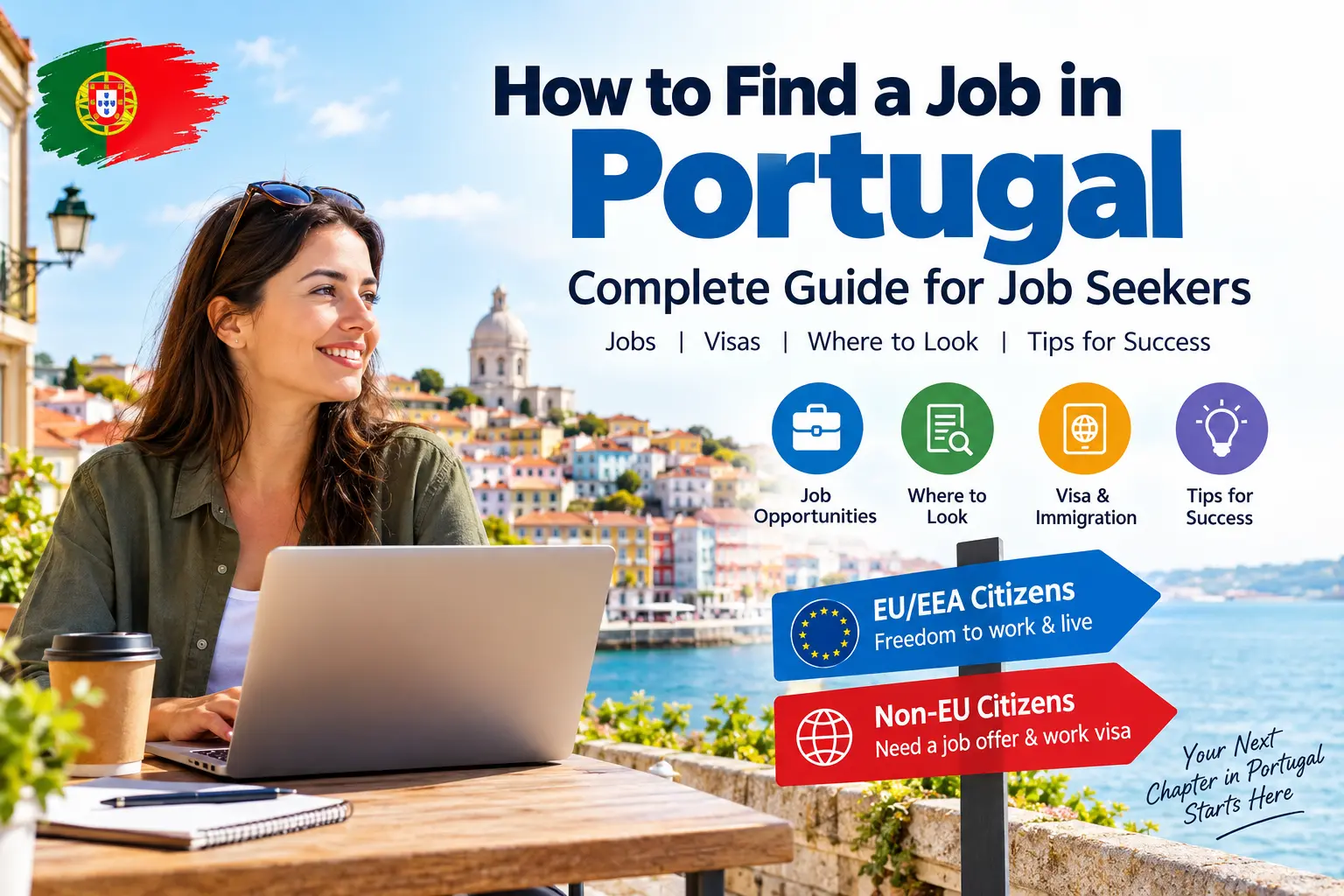
Portugal has become one of Europe’s more popular relocation destinations — a mild climate, a lower cost of living than much of Western Europe, and a growing tech and services sector. But “moving to Portugal for work” means something very different depending on whether you’re an EU/EEA citizen or not, and the rules for non-EU applicants have changed significantly. This guide walks through how the job market actually works, what to expect if you’re applying from abroad, and where to look for real opportunities — including real openings we’ve covered, like this Italian-speaking Content Moderator role in Porto and a live-in Family Helper position in Cascais.
This is general guidance, not legal or immigration advice. Visa and labour rules can change with little notice — always confirm current requirements directly with the relevant Portuguese authority before making decisions.
Who Can Work in Portugal Without a Visa
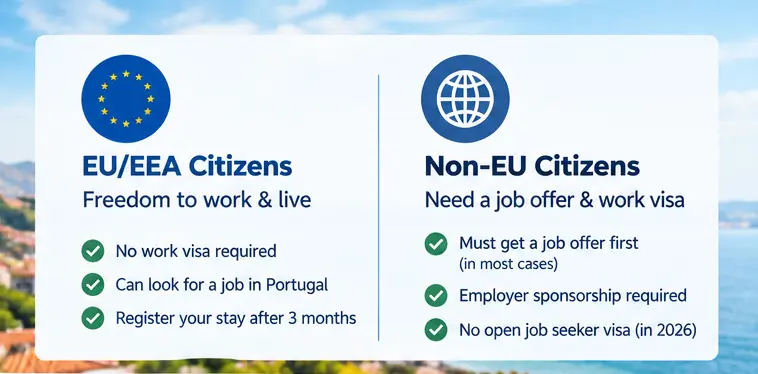
If you’re a citizen of an EU or EEA country (or Switzerland), you have freedom of movement rights under EU law: you can travel to Portugal, look for work, and take a job without a work visa. You’ll typically need to register your stay with local authorities once you pass three months of residence, but there’s no separate work-authorization step.
If you’re a non-EU/non-EEA citizen, you generally need permission to work before you can take up employment — and in most cases now, a job offer before you travel.
The Current Situation for Non-EU Job Seekers (Important Update)
For several years, Portugal’s “Job Seeker Visa” let non-EU nationals travel to Portugal without a job offer, look for work for up to 120 days (extendable by 60), and convert to a residence permit once hired. That route no longer works the way older articles describe it.

Under Law No. 61/2025, the previous Job Seeker Visa was withdrawn, with consulates ceasing to accept new applications for it from 23 October 2025. It was replaced in law by a new “Skilled Job Seeker Visa” (visto de procura de trabalho qualificado) under Article 57-A of the Foreigners’ Law — described on the official visa portal’s national visa overview — but this new visa requires implementing regulations that had not yet been published as of the most recent check.
In practical terms, this means: in 2026, most non-EU applicants need a confirmed job offer and an employer willing to sponsor a work-residence visa before travelling to Portugal — there currently isn’t an open route to arrive first and search once you’re there. This is exactly the kind of detail that changes without much notice, so before making any plans, check the current status directly on Portugal’s official visa portal rather than relying on older blog posts or agency marketing.
What Employers and Authorities Look For
Regardless of nationality, employers hiring internationally in Portugal generally want to see:
- Relevant qualifications or experience for the role (recognised degree, professional certification, or demonstrable work history)
- A CV formatted for the European market (Europass-style CVs are common and widely accepted)
- Language ability — Portuguese isn’t always required, especially in tech, tourism, and multinational companies based in Lisbon or Porto, but it significantly widens your options
- For regulated professions (healthcare, engineering, law, teaching), formal recognition of foreign qualifications by the relevant Portuguese professional body before you can practise
Looking at real listings helps here too — the Content Moderator role in Porto we covered, for example, specifies native or C1/C2 language ability as a hard requirement rather than a nice-to-have, which is typical for language-specific roles in Portugal’s growing BPO and content-review sector.
Salary Expectations
Compensation varies enormously by role, sector, experience, and city. As a general reference point, the national minimum wage in mainland Portugal is €920 gross per month, in effect from 1 January 2026, paid over 14 payments a year (the standard 12 months plus a Christmas bonus and a holiday bonus) rather than 12 — a structure that’s easy to misread if you’re comparing salaries to other countries. Regional minimums differ slightly in the Azores and Madeira.
This is a floor, not a typical salary — skilled roles in IT, engineering, and finance in Lisbon and Porto generally pay well above it. Live-in or accommodation-included roles, like caregiving and family-helper positions, are a different case, since part of the compensation is non-cash — always check the specific offer rather than relying on averages, and clarify whether a quoted figure is gross, net, monthly, or annual before comparing offers.
Where to Actually Look for Jobs
- IEFP (Instituto do Emprego e Formação Profissional) — Portugal’s public employment service, useful for both EU and (where applicable) non-EU applicants, and often involved in the paperwork for skilled-worker routes
- EURES — the EU’s official cross-border job mobility portal, aimed specifically at EU/EEA citizens looking to work in another member state
- Company career pages — for larger employers and multinationals with a Lisbon or Porto office, applying directly is often more effective than going through general job boards
- Sector-specific channels — LinkedIn, industry associations, and specialised recruiters tend to outperform generic job boards for skilled roles
- JobQora’s job listings — we cover individual openings as we verify them, with the source, requirements, and application details laid out plainly

How to Apply: A Practical Checklist
- Confirm whether you need a visa/work authorization at all, based on your nationality — check the official portal first, not a third-party summary.
- Get your qualifications assessed for recognition if you’re in a regulated profession.
- Build a Europass-style CV and a short, role-specific cover letter.
- Target roles directly rather than mass-applying — Portuguese employers hiring internationally usually want a clear reason you’re a fit.
- If you’ll need sponsorship, say so clearly and early — it affects which employers can realistically hire you.
- Once you have an offer, confirm the exact visa/residence-permit pathway with the employer’s HR team and the relevant consulate, since the process runs through the employer for most non-EU work visas now.
Common Mistakes to Avoid
- Assuming the old Job Seeker Visa is still open — check the current status before making travel plans around it
- Comparing a Portuguese salary to a 12-month figure when it’s actually paid over 14 instalments
- Applying broadly without tailoring your CV to Portuguese/European conventions
- Skipping qualification recognition for regulated professions, then discovering it late in the process
- Relying on relocation agencies or informal “guaranteed visa” offers instead of official government sources
Frequently Asked Questions
Do I need to speak Portuguese to get a job in Portugal? Not always. Many roles in tech, customer support for international markets, and multinational companies operate in English, especially in Lisbon and Porto. That said, Portuguese ability opens up significantly more roles, particularly outside major cities.
Can I move to Portugal without a job offer to look for work in person? For EU/EEA citizens, yes. For non-EU citizens, this generally isn’t currently possible the way it used to be — check the official visa portal for the current status of the Skilled Job Seeker Visa before assuming otherwise.
How long does it take to get a Portuguese work visa? Processing times vary by consulate, visa type, and case volume, and change over time. There’s no single reliable figure — check current estimated timelines with the consulate handling your application.
Is the cost of living in Portugal low enough to offset a lower salary? Portugal is generally more affordable than Western European countries like Germany, France, or the Netherlands, particularly for housing outside central Lisbon. But costs vary a lot by city and have been rising, so it’s worth researching your specific target city rather than relying on general “cheap country” assumptions.
What’s the difference between a work visa and a residence permit? A work visa typically allows initial entry; once in Portugal, most workers then apply for a residence permit through AIMA (Agência para a Integração, Migrações e Asilo), the agency that replaced SEF for immigration matters, which allows longer-term legal residence and work.
Next Step
If you’re serious about working in Portugal, start with two things in parallel: confirm your actual visa pathway on the official Portuguese visa portal based on your nationality, and start tailoring applications toward employers who are realistically positioned to hire internationally. Chasing job listings before you understand the legal route tends to waste the most time — browse our current Portugal listings or read more about how JobQora researches and verifies opportunities before you dive in. If you spot anything in this guide that’s changed, let us know — visa rules move fast and we’d rather correct it than leave it stale.